



Osteochondrosis of the cervical spine is one of the most common spinal diseases, which can be explained by the high mobility of this part of the body.As the disease progresses, severe pain develops, which significantly impairs a person's quality of life.That is why it is so important to consult a doctor at the first manifestations of pathology.
Clinic for osteochondrosis of the cervical spine
The disorder is progressive in nature and consists of the appearance of dystrophic changes in the intervertebral discs.There are seven vertebrae here which provide free movement of the head.Due to increased physical activity or insufficiently strong muscles, this part of the spine is often subject to such a violation.
As the disease develops, the metabolic processes in the spine are disrupted, the strength and elasticity of the intervertebral disc disappear, and increased loads lead to the appearance of cracks on the annulus fibrosus.As the process develops, a protrusion or hernia appears.
Degrees of development
- First degree.The disease causes few symptoms.A person feels slight pain in the neck, increasing when turning the head.During the examination, the doctor may detect slight muscle tension.
- Second degree.This form is characterized by noticeable pain and can radiate towards the arm or shoulder.This is explained by a violation of the height of the disc, which causes pinching of the nerves.The pain becomes stronger with head movements.This condition is characterized by headaches, increased weakness and decreased work capacity.
- Third degree.The manifestations of the anomaly intensify several times, and the pain is constantly present.They can be felt not only in the neck itself, but also on the shoulder or arm.The formation of a hernia causes weakness in the arm.A person complains of chronic fatigue and dizziness.During the examination, the doctor may detect reduced mobility of the neck.Additionally, the patient feels pain on palpation.
- Fourth degree.At this stage, the intervertebral disc is completely destroyed, resulting in the formation of connective tissue in its place.The patient also experiences a significant increase in dizziness, impaired coordination of movements and tinnitus.Such symptoms are a consequence of the involvement of the vertebral artery in the pathological process - it is responsible for supplying the cerebellum and part of the brain.
Reasons
Under the influence of various factors, the load on the cervical spine increases.The muscles try to compensate for this process, causing spasms and problems with blood circulation.For this reason, degenerative processes occur.
The main causes of the disease are:
- deficit of motor activity;
- metabolic disorder;
- poor posture;
- excess weight;
- scoliosis;
- systematic muscle tension;
- stressful situations;
- dysplastic connective tissue abnormalities;
- blood circulation problems in the neck area;
- heredity;
- uncontrolled physical activity;
- spinal abnormalities.
Contrary to popular belief, osteochondrosis cannot be detected only in older people.Today, such a violation is not uncommon even among children and adolescents.In addition, the number of cases of illness among people aged 18 to 30 is increasing significantly.
Symptoms and signs of the disease
Almost everyone has symptoms of osteochondrosis.If they are associated with severe pain, you should immediately consult a doctor.Signs of pathology include:
- Neck pain.They can radiate to the back of the head, shoulders, eyes or ears.Very often they are felt during movements.Sometimes there are pains of a throbbing nature.
- Pain in the arms.Discomfort may also be felt in the shoulder, hand and forearm, and it persists even at night.
- Impaired activity of hands and fingers.The person may lose sensation and muscle strength.
- Muscle tension in the morning.
- Tinnitus.
- Headaches.Typically, they begin to be felt at the back of the head, then move to the temples and crown of the head.
- Numbness and tingling in the limbs.
- Fainting, dizziness, darkening of the eyes.Such signs most often appear during careless movements of the head.
- Numbness of the tongue.
- Deterioration of hearing and vision.
- Pain in the region of the heart.
- Increase in the size of the connective tissue in the neck.
- Sleep, memory and attention problems.
- Voice changes - the appearance of hoarseness, weakening of the voice, etc.
Symptoms of cervicothoracic osteochondrosis
Disorders of this part of the spine are characterized by the following manifestations:
- systematic headaches;
- intercostal neuralgia;
- pressure changes;
- loss of coordination of movements;
- dizziness;
- chronic fatigue;
- heart pain;
- infectious pathologies;
- flashing dots in front of the eyes;
- tinnitus;
- numbness of fingers;
- pain in arms and shoulders.
This form of osteochondrosis causes many syndromes and can lead to problems in the functioning of certain organs.
For example, this pathology often causes heart disease.Therefore, if these symptoms appear, you should immediately consult a doctor.
Syndrome
In addition to general manifestations, cervical osteochondrosis is characterized by a number of syndromes.Thanks to these signs, it is possible to make an accurate diagnosis and choose treatment.
Koreshkovy
This condition is also often called cervical sciatica.Radicular syndrome is the result of pinched nerves in the neck.As this process progresses, the pain spreads downward, reaching the shoulder blades.They can affect the forearms and fingers.Sometimes patients complain of goosebumps and tingling sensations.
The manifestations of the disorder are determined by the location of the pathology.So, when the roots of the central nerve are pinched, swelling occurs, which affects the thumb, middle finger and index finger.If the roots of the brachial nerve are affected, the process affects the little and ring fingers.
Irritative reflex
This condition is characterized by intense pain, localized in the neck or back of the head.Often the discomfort intensifies after a sudden movement.Examples of this condition include pain after sleep, when the patient suddenly turns their head.Discomfort may also be felt in the chest or shoulder.
Vertebral artery syndrome
The main symptom is a headache, which may be throbbing or burning.They often extend to the back of the head, crown of the head, and temples.Also, discomfort is often felt above the eyebrows.The pain intensifies after prolonged movement.Additionally, discomfort increases after being in an uncomfortable position.When immunity decreases, nausea, fainting, hearing problems and disturbances in the functioning of the vestibular apparatus are possible.Additionally, vertebral artery syndrome often causes vision problems.Eye pain may occur.
Cardiac
The first symptoms to appear are angina.That is why there is a risk of unnecessary treatment of angina instead of eliminating the main cause of discomfort.
The development of cardiac syndrome is caused by pinching of the roots of the phrenic nerve or pectoral muscles.Paroxysmal pain may occur and last for a long time.Additionally, discomfort increases with sneezing, coughing and imprecise head movements.
This syndrome is accompanied by tachycardia and extrasystole.In such a situation, the pain does not subside even after using antianginal medications.If you do a cardiogram during an attack, it will not show any symptoms of circulatory problems.
Complications and consequences
The most dangerous complications include:
- Protrusion of discs, which causes the formation of a herniation.
- Disc rupture with pinching of nerves and blood vessels.In this condition, the spinal cord can be compressed, which is life-threatening.
- Radiculopathy is a disorder of the nerve roots.
- Formation of osteophytes - so-called spines on the vertebrae.As a result, paresis and paralysis often occur.
A dangerous complication of this form of osteochondrosis can be Dupuytren's disease.
In this case, human tendons lose their ability to stretch.As a result, the fingers become deformed and can no longer function properly.
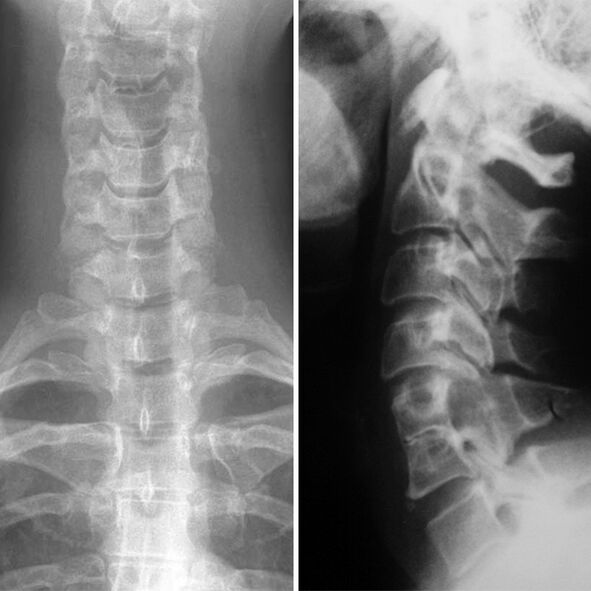
Diagnosis
To diagnose the disorder, you need to consult a neurologist.The specialist will prescribe the following types of studies:
- x-ray;
- CT scan;
- magnetic resonance imaging.
A Doppler ultrasound can be performed to assess the condition of the cervical vessels.In case of blood circulation problems, a rheoencephalography should be performed.You must also contact an ophthalmologist who will carry out a fundus examination.
How to treat
To achieve the desired results, the treatment must be comprehensive.For this purpose, medicinal and non-medicinal methods are used.Doctors often prescribe medications that help relieve pain and inflammation.
It is imperative to take medications to normalize cerebral circulation.If the pathology causes muscle tension, relaxers should be taken.In addition, vitamin complexes are very useful.
Physiotherapy plays an important role in the treatment of the disease.Paraffin baths and electrophoresis are particularly useful.Aquatic treatments, hirudotherapy, massage, acupuncture and magnetotherapy are also often prescribed.However, therapeutic exercises are considered the most effective treatment method.In particularly difficult situations, surgical intervention cannot be avoided.
Osteochondrosis of the cervical spine belongs to the category of quite dangerous disorders, since it not only causes pain, but can also lead to serious consequences.To avoid complications, you should consult a doctor if you experience neck discomfort.